




If you’re searching for the Nasarawa State University cut off mark for Medicine and Surgery, you’re not alone. Every year, thousands of UTME candidates and parents type this exact phrase into Google, hoping to find clear, accurate, and realistic information that can guide their admission plans. This article is written to do exactly that—no guesswork, no vague statements, and no recycled campus gist.
By the time you finish reading, you will clearly understand:
- The official Nasarawa State University cut off mark for Medicine and Surgery
- Why Medicine and Surgery is highly competitive at NSUK
- How Post-UTME, O’Level results, and catchment considerations affect admission
- What score you realistically need to be safe
- Smart strategies to improve your chances
- Frequently asked questions many candidates forget to ask
This guide is written in simple, human language, optimized for search, and designed to help you make informed admission decisions.
Understanding Nasarawa State University and Its College of Medicine
Nasarawa State University (NSUK), located in Keffi, Nasarawa State, is a state-owned university established to expand access to quality higher education in Nigeria. Over the years, NSUK has grown steadily in infrastructure, academic staffing, and programme accreditation.
Medicine and Surgery (MBBS) is one of the most sought-after programmes in the university. Because of its professional status, limited admission quota, and strict regulatory standards set by the Medical and Dental Council of Nigeria (MDCN), admission into Medicine and Surgery at NSUK is highly competitive.
This competitiveness directly affects the Nasarawa State University cut off mark for Medicine and Surgery, making it significantly higher than most other courses.
What Does “Cut Off Mark” Mean in Nigerian Universities?
Before diving into the figures, it is important to clearly understand what a cut off mark means in practice.
A cut off mark is the minimum score a candidate must attain in UTME (and subsequently Post-UTME) to be considered for admission into a particular course. There are two major types:
1. JAMB General Cut Off Mark
This is the minimum UTME score approved by JAMB for universities. It only qualifies you to apply; it does not guarantee admission.
2. Departmental Cut Off Mark
This is the actual score set by the university or department after considering:
- Number of applicants
- Available admission quota
- Overall performance of candidates
For Medicine and Surgery, the departmental cut off mark is what truly matters.
Nasarawa State University General JAMB Cut Off Mark
Nasarawa State University usually adopts a general JAMB cut off mark of 160 for most courses. However, this score does not apply to Medicine and Surgery.
Many candidates make the mistake of assuming that once they score above 160, they are safe for any course. This assumption often leads to disappointment.
For Medicine and Surgery, NSUK sets a much higher benchmark.
Nasarawa State University Cut Off Mark for Medicine and Surgery
Here is the key information you are looking for.
Official Departmental Range
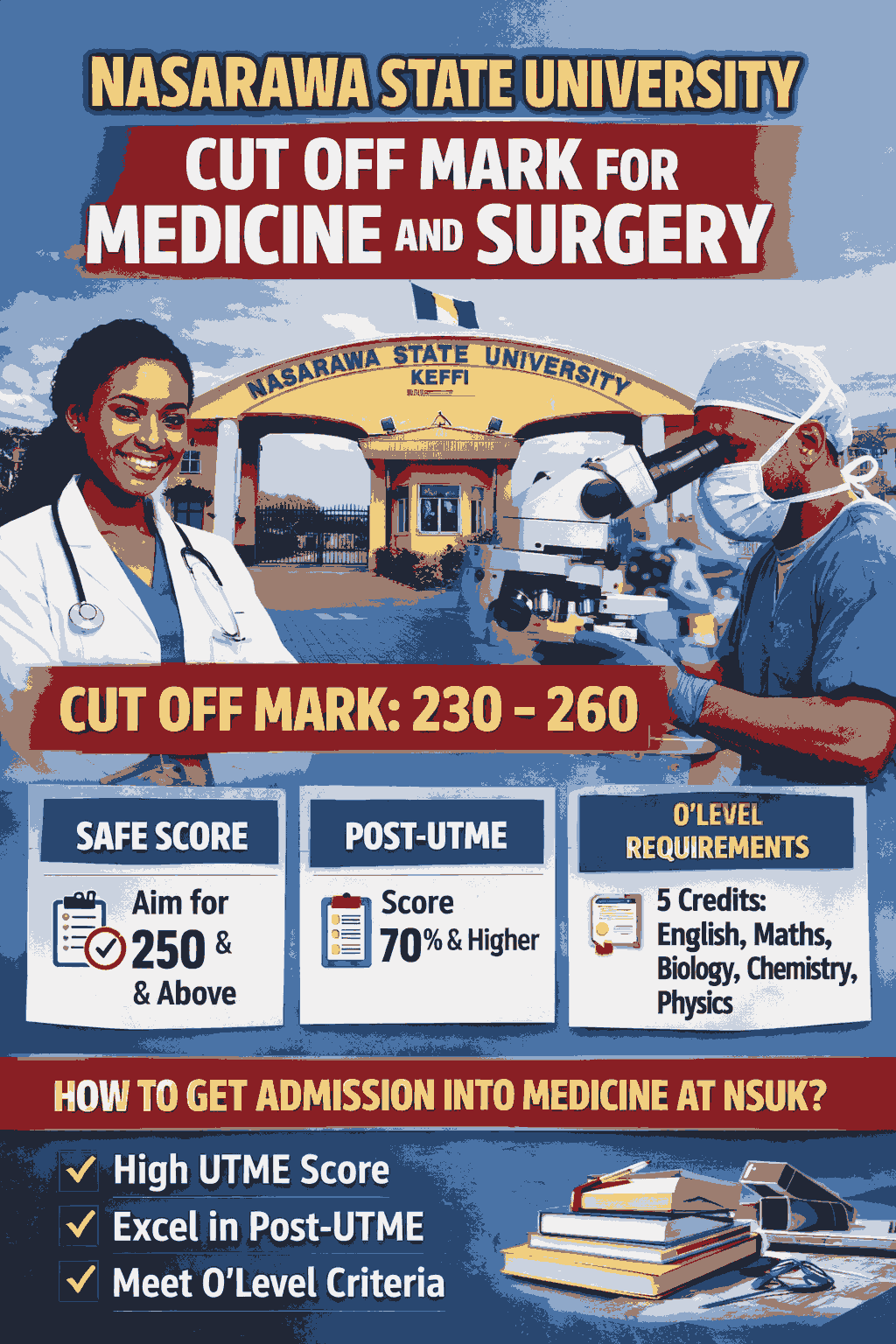
The Nasarawa State University cut off mark for Medicine and Surgery typically falls within the range of:
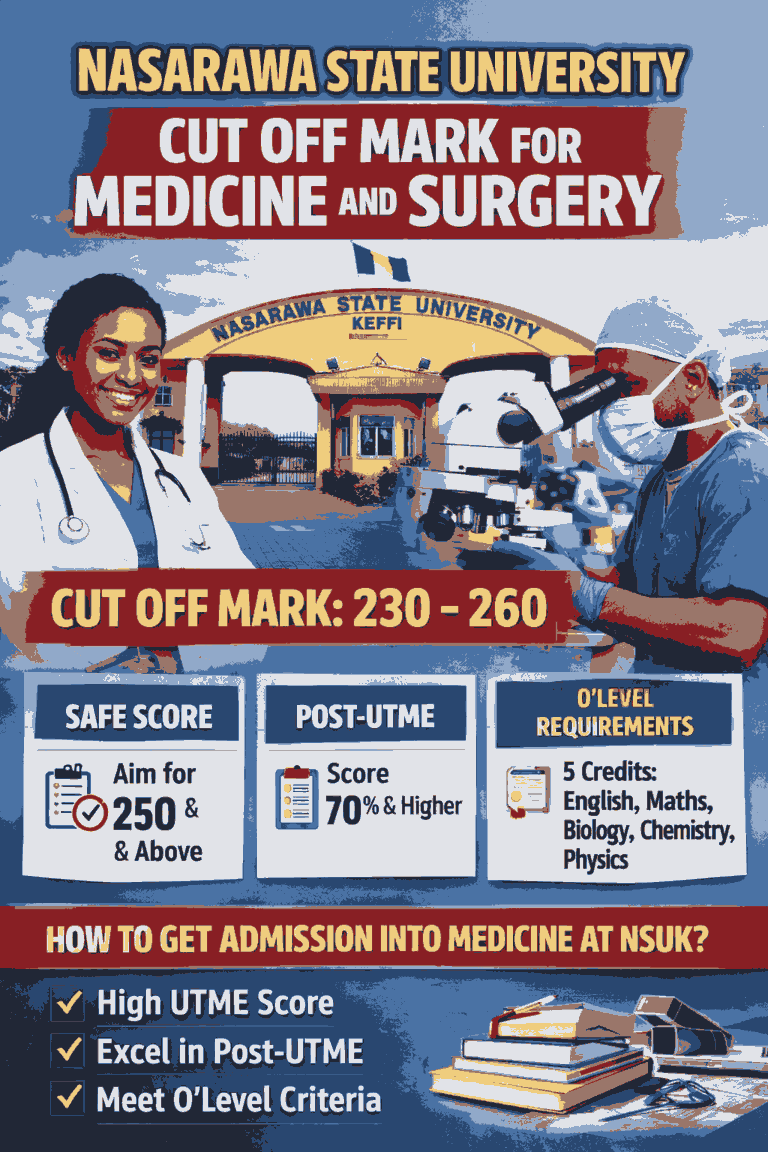
230 – 260 in UTME
This range may vary slightly from year to year depending on:
- Candidate performance nationwide
- Admission quota approved for NSUK
- Number of applicants choosing Medicine and Surgery
Safe Score Recommendation
If you are serious about Medicine and Surgery at NSUK, a safe UTME score is:
250 and above
Anything below 230 significantly reduces your chances, even if you perform well in Post-UTME.
Why the Cut Off Mark for Medicine and Surgery Is High
Many candidates ask why the Nasarawa State University cut off mark for Medicine and Surgery is always higher than other courses. The reasons are practical, not arbitrary.
1. Limited Admission Quota
Medical programmes are strictly regulated. NSUK can only admit a small number of students each year, regardless of how many apply.
2. High Demand
Medicine and Surgery attracts candidates with very high UTME scores, pushing the average upward.
3. Professional Accreditation Standards
Facilities, teaching hospitals, and staff-to-student ratios must meet MDCN requirements, limiting intake.
Post-UTME and Its Role in Final Admission
Scoring high in UTME is only the first step. NSUK conducts Post-UTME screening, which plays a critical role in determining who finally gets admitted.
How Post-UTME Affects Your Chances
- A strong UTME score combined with poor Post-UTME performance can still cost you admission
- Candidates with slightly lower UTME scores may overtake others through excellent Post-UTME results
What to Aim For
To remain competitive:
- UTME: 250+
- Post-UTME: 70% and above
Together, these greatly strengthen your admission profile.
O’Level Requirements for Medicine and Surgery at NSUK
Meeting the Nasarawa State University cut off mark for Medicine and Surgery alone is not enough if your O’Level results are weak.
Required Subjects
You must have at least five credits, including:
- English Language
- Mathematics
- Physics
- Chemistry
- Biology
Important Notes
- Credits must be obtained in not more than two sittings
- A single sitting is strongly preferred for Medicine and Surgery
- Any deficiency can lead to automatic disqualification
Does Catchment Area or State of Origin Matter?
Yes, but only slightly.
As a state-owned university, NSUK may give minor consideration to candidates from:
- Nasarawa State
- Neighboring states within the university’s catchment area
However, for Medicine and Surgery, merit comes first. Even candidates from Nasarawa State must meet the high cut off mark.
Common Mistakes Candidates Make
Many candidates fail not because they are not intelligent, but because they misunderstand the system.
Mistake 1: Applying with a Low UTME Score
Choosing Medicine and Surgery with 200–210 UTME is extremely risky.
Mistake 2: Ignoring Post-UTME Preparation
Some candidates relax after UTME, forgetting that Post-UTME can make or break admission.
Mistake 3: Poor Subject Combination
Wrong UTME subject combination automatically disqualifies you, regardless of score.
Smart Strategies to Improve Your Chances
If Medicine and Surgery at NSUK is your goal, here’s what works:
1. Target a High UTME Score
Start preparing early and aim for 260+ if possible.
2. Take Post-UTME Seriously
Study past questions and understand NSUK’s screening pattern.
3. Have a Backup Course
Consider related courses like Anatomy, Physiology, or Nursing (if available), in case competition becomes too stiff.
4. Monitor Official Updates
Always rely on NSUK’s official announcements, not rumors.
What If You Don’t Meet the Cut Off Mark?
Not meeting the Nasarawa State University cut off mark for Medicine and Surgery does not mean your academic dream is over.
You can:
- Change to a less competitive course
- Apply to another university with a lower cut off
- Retake UTME and improve your score next year
Many successful doctors today didn’t get admitted on their first attempt.
Conclusion
The Nasarawa State University cut off mark for Medicine and Surgery is high because the course is competitive, regulated, and in high demand. While the general university cut off mark may be around 160, Medicine and Surgery typically requires 230–260, with 250 and above being the safest zone.
Admission success depends on a combination of factors: UTME score, Post-UTME performance, O’Level results, and careful application choices. With the right preparation and realistic expectations, gaining admission into Medicine and Surgery at NSUK is achievable.
Also Read: Cut Off Mark for Medicine and Surgery in KWASU (2026 Admission Guide)
Frequently Asked Questions (FAQs)
1. What is the exact cut off mark for Medicine and Surgery at Nasarawa State University?
The cut off mark usually falls between 230 and 260, depending on the admission year and candidate performance.
2. Can I study Medicine and Surgery at NSUK with 220 in UTME?
Your chances are very slim. A score of 250 and above is strongly recommended.
3. Does NSUK accept two sittings for Medicine and Surgery?
Yes, but a single sitting with strong credits is preferred due to the competitiveness of the course.










+ There are no comments
Add yours